How being a B Corp helps showcase your mission and values
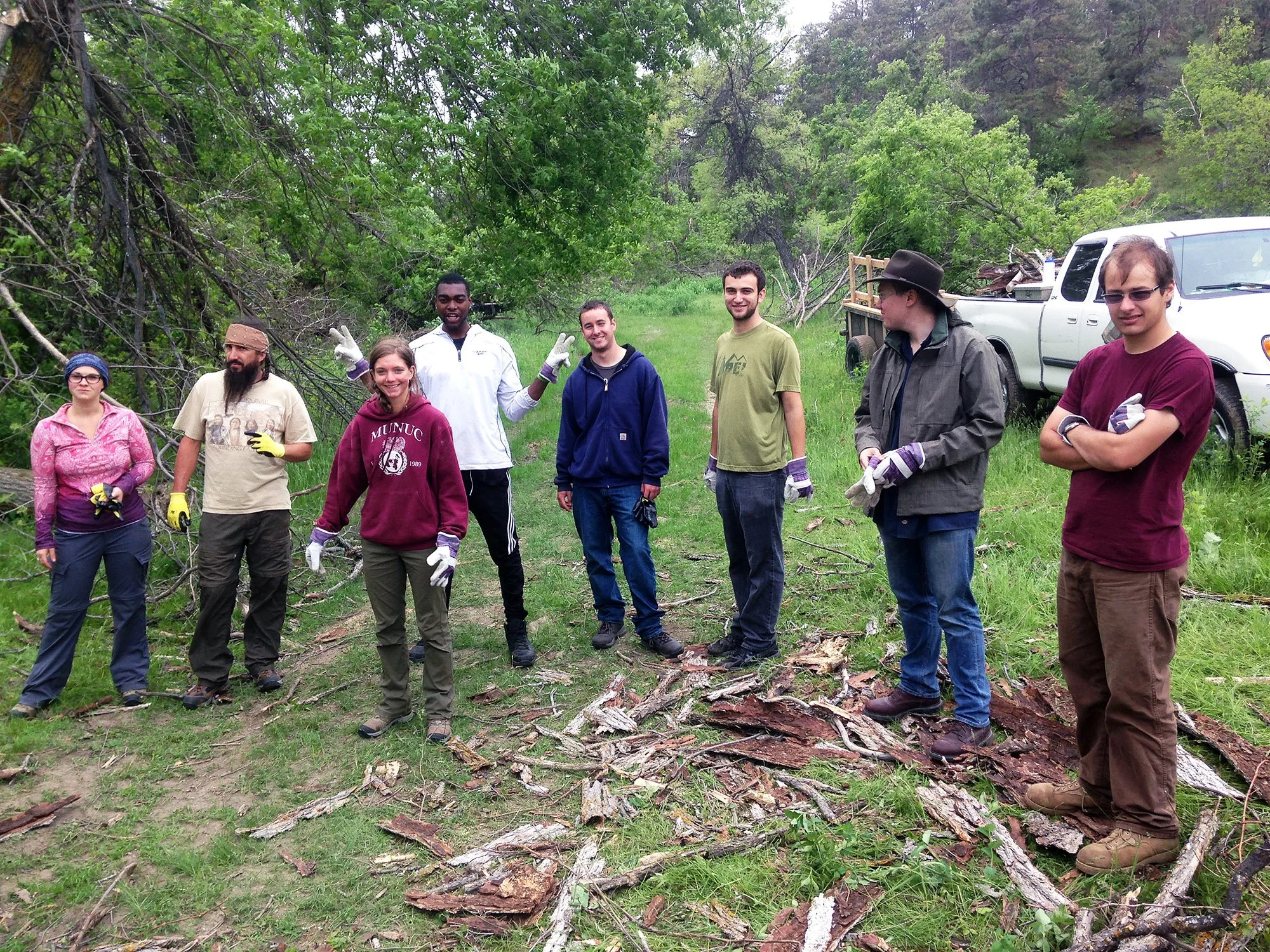
Sweet Grass field school participants cut wood for Iron Cloud family members near the Pine Ridge Indian Reservation in South Dakota.
If you’ve ever worked for a mission-driven company, you’ve probably heard of a B Corp. Certified B Corps are for-profit businesses that are committed to responsible business practices and put people before profit. The process of becoming a B Corp–certified company is overseen by B Lab, a nonprofit network that determines whether a business meets specific social, environmental, and governance standards. This is done through the B Impact Assessment, which is a pretty rigorous review process that evaluates your mission, employee benefits, environmental practices, and community impact. Every three years, it confirms if your business is providing a public benefit.
B Lab will tell you that Certified B Corps are part of a global movement, and I think that’s true. As of today, there are 10,629 Certified B Corps in 104 countries around the world. That means if one business has to revise its business practices to comply with B Corp standards, thousands of others do, too. By sheer scale, this creates a systemic change that can affect hundreds of industries and millions of people. It’s certainly more than any one B Corp could do on its own.
Why mission-driven businesses become B Corps
Sweet Grass earned its B Corp Certification in 2022 after two of our close clients recommended it to our co-founders, Andrea Mader and Michael Brydge. “We knew we were doing things in very cool ways,” says Andrea, “and we wanted the certification to prove that we were doing them. People assume for-profit companies are ‘profit hungry’ and don’t make sacrifices for staff and community well-being. We didn't necessarily need the validation, but we appreciated the opportunity to show what we valued.”
Both Andrea and Michael say the certification process was time-consuming, but worth it. “It took us about 80 hours to apply for certification and address the areas we needed to improve,” says Michael. “For years, we wanted to track our own outcomes, outputs, and impact in relation to our values and actions. Without B Lab setting and raising the bar, I would have never thought things like employee health benefits and home-office amenities could be part of those metrics. It even includes how we encourage our employees to be part of their local communities outside the workplace.”
There are lots of reasons why a community-driven business would pursue B Corp Certification, and why it might matter to their clients and customers. For one, the B Corp framework legally requires your company to actively engage in making a positive impact by focusing on your employees, the community, and the environment. Michael says he appreciates “having metrics to strive for as we continue to grow and develop” and that “an outside pair of eyes helps us raise our standards and gives us an impact measurement system” (something we love).
To potential employees, B Corp Certification signals that your company cares about building a positive work environment and is committed to maintaining a healthy workplace culture. I asked our own team members to share their perspectives on what it means to work for a B Corp, and the results were overwhelmingly positive. Eighty percent of staff said that it was important to them when they applied for their role at Sweet Grass, and all staff members value working for “an organization that is willing to examine its own practices and be evaluated against standards related to governance, workers, community, and the environment.” As one staff member stated, “B Corp Certification, to me, represents a commitment to continually thinking about impact [in a way] that ensures the least harm and the most good for the greatest number of people. That commitment both aligns with my values and inspires me to further act in support of them.”
It matters to me that the principals built a company with real intention and had the desire to demonstrate that a for-profit business can ethically serve and prioritize integrity, people, and long-term impact alongside financial sustainability.
—Sweet Grass staff member
As to whether it matters to our clients, feedback from our team was mixed: Half believed it made a difference, and half said they weren’t sure. “I do think it matters that we’re actually living the values and intentions by being B Corp–certified, but I’m not sure it’s had an impact yet,” says Andrea. In 2023, over one-third of adults in the US were familiar with B Corps, with Millennial and Gen Z awareness the highest at 51%. That’s a lot, but there’s still a gap in knowledge about what B Corp Certification means. One of the challenges we’ve had as a research and consulting firm is that B Corps are traditionally known for their focus on environmentalism and fair trade. But as B Corp standards continue to become more human- and impact-centric, it’ll help create awareness for community-focused businesses like Sweet Grass.
Upholding B Corp standards and earning public trust
With the many benefits that being a Certified B Corp provides, there’ve been a few controversies since the movement’s inception in 2006. As global interest in B Corp Certification grows, so does the criticism. In 2024, the large French advertising agency Havas was stripped of its B Corp status after activists and other agencies condemned its contract with Shell. There was also widespread backlash when Nespresso and Unilever received B Corp Certifications. Certifying large multinational corporations that have subpar environmental and trade practices motivated Dr. Bronner’s to publicly denounce B Lab’s integrity and voluntarily drop its own certification after previously achieving the highest impact score on record.
B Lab, for its part, recently completed an in-depth, multi-year review process and rolled out its new B Lab standards, which are said to be even more rigorous and transparent, with stricter requirements for carbon management and reporting. “These new standards are a more elevated way to think about what it means to be a B Corp,” says Patia Ingraldi, operations director at Sweet Grass. “The updates make it clear that organizations need to think beyond ‘being good’ as just a baseline or only in a few key areas. Businesses need to show continuous commitment to truly holistic improvement.”
B Lab’s new standards will do a better job of holding these large corporations more accountable, but I’m a little concerned that small firms like ours won’t have the resources or infrastructure to meet them. This could potentially prevent certification for companies that are very committed to creating social good but don’t have the capacity to meet the strict guidelines, perhaps widening the corporate divide even further. Patia doesn’t see it that way. According to her, “You can choose to be intimidated or inspired by that, and I’d say I’m in the inspired camp (okay, maybe with 10% intimidation!). I’m looking at our impact measurement areas early and often to see where we have opportunities to take something good and make it even better. I’m excited by the possibilities, and I’m optimistic about our odds of maintaining a certification that’s a natural reflection of who Sweet Grass is and how we operate.”
B Corps and B Corp standards are by no means perfect, but the efforts of B Lab and the individual companies pursuing certification are demonstrably important. Any efforts to create “an inclusive, equitable, and regenerative economy” are even more important in a political climate where profit and power prevail, leaving people and the planet to trail behind. In an environment that’s becoming increasingly hostile to organizations working for the social good, B Corps are fighting for a collective vision of a world that supports both workers and the earth.
Two of the seven core values at Sweet Grass are respect and transparency. We show respect for each other and the communities we work with, and we are accountable for our words and actions. “When we talk about working with and alongside marginalized communities, we mean it,” says Andrea. “B Corp gives us a grading system to prove it, but we’re also part of creating a shared community standard for what this work can look like.” The goal of a B Corp is to balance purpose with profit, and when you’re honest and transparent with your business practices, you can distinguish yourself as a truly ethical company.
Share