Designing research tribal leaders can use

Wind turbines on the Rocky Boy’s Reservation, home to the Chippewa Cree Tribe, near Havre, Montana.
During an early meeting on a tribal clean energy planning project a few years ago, a tribal leader said something I still carry with me:
“We’ve answered a lot of surveys over the years. What we need now is research we can actually use.”
For years, the tribe had participated in research projects. Researchers collected data on household energy use, consumer beliefs, and infrastructure needs. They produced reports and shared them with the tribe. But when tribal leadership gathered to decide whether to pursue federal infrastructure funding, invest in solar development, or restructure utility governance, those reports did not answer the questions before them. The research described conditions in the community, but it did not support decisions.
This experience reshaped how I think about research. At the time, I was working as a social scientist at the US Environmental Protection Agency, leading climate-related research in collaboration with Tribal Nations. I saw how often federal timelines and reporting requirements affected projects more than local governance priorities did. The research was well intentioned and the teams were committed, but the work did not always fully align with the needs of tribal leadership.
Those experiences led me to begin asking a different question at the start of each project. I started asking what authority the research would strengthen. That shift continues to shape how I approach projects at Sweet Grass today.
Designing research that supports leadership decisions
Tribal governments make decisions every day that shape the future of their nations. These decisions involve infrastructure investments, regulatory authority, economic development strategies, and stewardship of lands and resources. Many of these choices carry long-term implications for governance, financing, and community well-being. Research becomes valuable when it clarifies those choices and provides information that leaders can use as they weigh different paths forward.
In many of our projects, the topic of the research is already defined before the work begins. Federal grant programs, philanthropic initiatives, and requests for proposals often establish the general focus of a project. What remains open is how the research is designed. The framing of the research questions, the structure of the methods, and the organization of the analysis determine whether the work produces a report that documents conditions or analysis that helps leaders evaluate options.
At Sweet Grass, our role is to translate funded projects into research that supports decision-making. When we begin a project, we start by identifying the governance decisions the work is meant to inform. Then we work with tribal leadership to refine research questions, design methods, and structure analysis so the work produces information leaders can use. This work often involves clarifying the decisions a project is meant to inform and ensuring that the research process produces information that can support those decisions.
In our clean energy work with Tribal Nations in Montana, those decisions may include whether to invest in distributed solar systems, whether utility rate structures should change and how they should be designed, or whether authority over energy systems should shift toward a tribally controlled utility. These choices carry financial, legal, environmental, and governance implications.
Repairing a history of extractive research
For generations, Indigenous communities and Native Nations have been some of the most studied yet least benefited populations in North America. Research has followed a familiar pattern: Outside experts arrive, collect data, publish findings, and move on. Reports may be technically strong, but they often remain disconnected from the priorities communities are actively navigating.
This history is one reason tribal research review boards and data governance policies exist. These systems protect tribal sovereignty, safeguard Indigenous knowledge systems, and ensure research produces benefits defined by the nation itself.
At Sweet Grass, we take that responsibility seriously. Working with Tribal Nations means beginning with the decisions leaders are already navigating, designing a partnership that respects tribal governance, and producing tools that can be used immediately. The goal is to support leadership with clear, actionable information that leaders can use immediately.
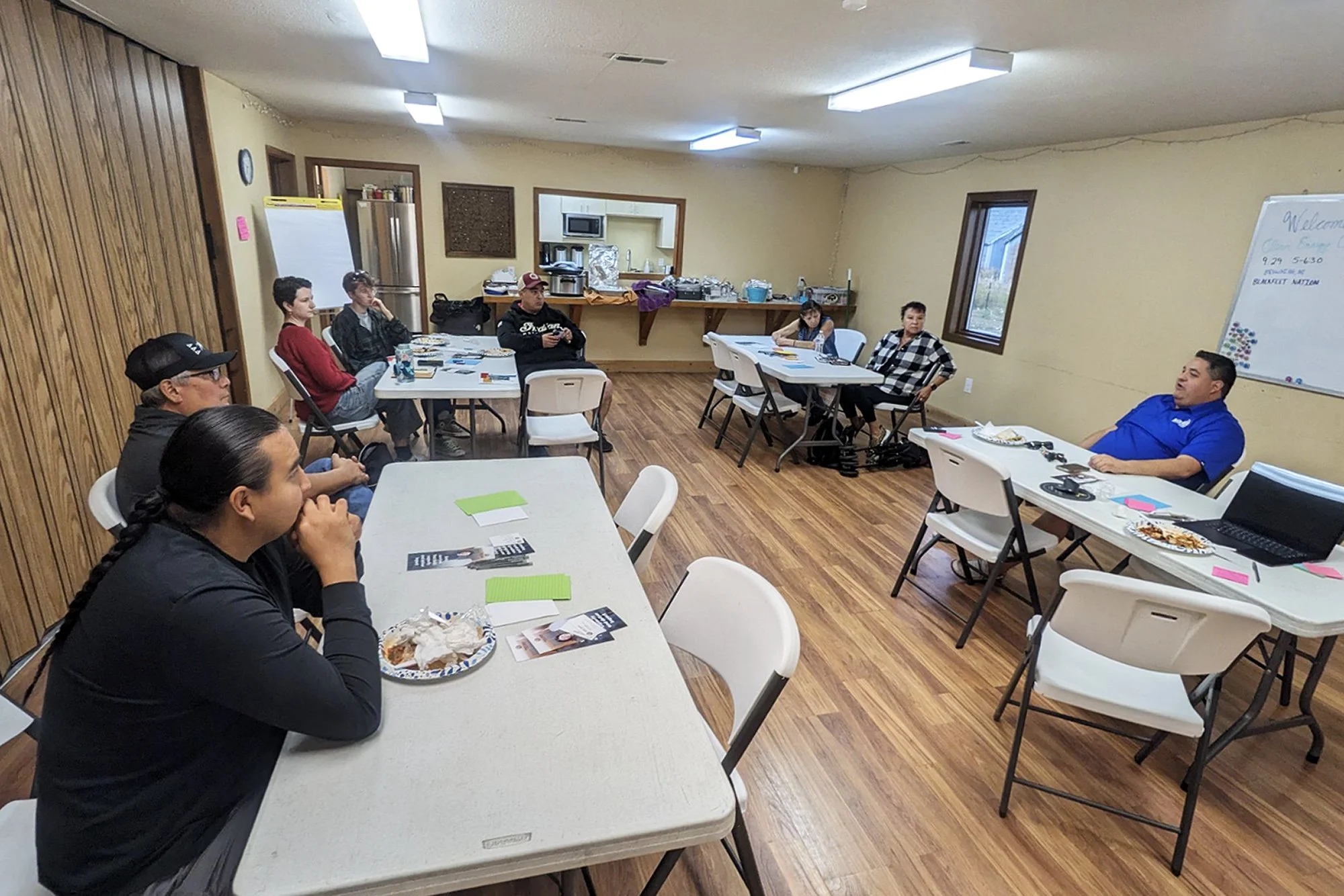
Members of the Blackfeet Nation in northwestern Montana participate in clean energy discussions in 2025.
Recognizing tribal governance and sovereignty
Tribal Nations are sovereign nations with the right to self-governance, and they have government-to-government relationships with the United States. Though there are many Indigenous communities and tribes across the country that aren’t federally recognized, in those cases too, all interactions and relationships must be based on respect and honor of tribal authority. That responsibility extends to how data from the research is handled. How data is owned, interpreted, and shared reflects sovereignty and our responsibility to tribal community members. Working with communities means they own the data. They determine how findings are interpreted, what remains internal, and what can be shared publicly.
Indigenous peoples have been collecting data and developing knowledge systems since time immemorial. Recognizing and working within those systems is foundational to our approach to community-led research. It also means recognizing the body of work many Tribal Nations have already developed. Communities do not begin at zero. Many Tribal Nations have decades of strategic plans, feasibility studies, community assessments, and market analyses that reflect years of leadership, planning, and community engagement.
For that reason, our work begins by reviewing existing plans and studies, identifying where additional clarity may be helpful, and building forward from what communities have already developed. This approach honors the labor and leadership that already exists and reduces unnecessary burden. Tribal Nations are already navigating complex decisions every day. Research should support that ongoing work rather than restart it.
When research strengthens leadership
Over time, I have come to see that the most meaningful research for Tribal Nations strengthens leaders’ ability to make decisions about the future of their nations. Indigenous communities are already shaping their futures. Tribal leaders make decisions about governance, infrastructure, economic development, and cultural continuity every day. Research becomes useful when it supports those decisions with careful analysis, facilitation, and information that leaders can draw on as they plan the future of their nations.
In this sense, research becomes part of governance. The information produced through a project helps leaders evaluate options, allocate resources, and make decisions that shape the long-term direction of their communities. In practice, research that supports leadership decisions does three things. It clarifies the choices leaders are weighing. It analyzes the implications of those choices for governance, financing, and community well-being. It presents the findings in ways that leadership can use in real decision processes.
When research reflects community-defined priorities and is aligned with sovereignty, the results are tangible. Funding proposals are stronger. Implementation moves more smoothly because leaders have the information they need to act. Community members recognize their perspectives in the outcomes because those perspectives shaped the work from the start.
One of the clearest indicators that the research is serving its purpose appears when a leader reads the work and says, “This reflects us.” When that happens, the analysis has reinforced leadership and supported decisions already underway.
Working with Tribal Nations and communities begins with a commitment that shapes every stage of the project. The guiding question is straightforward: Does this work increase a community’s ability to decide its future on its own terms?
When the answer is yes, the research becomes part of how that community governs and plans for the future. The goal is to produce work that supports action and strengthens the decisions communities will continue to make in the years ahead. Research should leave communities better equipped to make decisions on their own terms.
Share