Jackie Carter at the border of Zambia and Zimbabwe in Africa.
The US is home to about 1.3 nonprofit organizations per 1,000 residents. Within each nonprofit, a slew of programs exist, each designed to address a particular need, like providing extra support to students, improving access to health care, or supporting teen parents. Each of these programs exists for a reason and with a vision. That vision is often rooted in someone’s lived experience with an issue or unmet need. Over time, however, the vision can become secondary and tailored to fit funding priorities or align with grant requirements. In the process, programs can begin to drift from the experiences that gave rise to them in the first place.
As a researcher, I work with a lot of programs. I spend most of my time thinking about the kinds of questions I need to ask in order to best help the program I’m working with. Ultimately, my goal is to give the program the data it needs to make informed decisions. The way the research is designed matters because the questions we ask, who we ask, and how we listen helps determine what a program comes to understand about the people it serves. The information we learn during a research project is only as strong or valid as the research design behind it. So, that research holds a lot of power.
My understanding of that power has been shaped by personal and professional experiences. Prior to joining Sweet Grass, I worked almost exclusively in international settings. In many of these roles, I watched foreigners, not unlike myself, develop broad programs and processes without meaningfully consulting local communities or accounting for the context in which these programs would be carried out.
In one instance, I attended a week-long training session packed with wordy PowerPoint slides designed to teach all of the country’s teachers how to incorporate sex ed into their curricula. The format of the training was very Western, and the approach offered no baseline understanding of a school’s situation or teachers’ comfort and familiarity with the topic, nor did it distinguish between grade level or subject matter. It also didn’t account for particular school practices like surprise pregnancy testing of teenagers or suspending female students for becoming pregnant. Of course the program was well intentioned. But without taking the time, resources, and effort to understand the context of one school or region at a time, it was poorly positioned to create meaningful or lasting change.
In this case, the lack of attention to local context risked reinforcing the very inequities the program set out to address. It treated teachers and students as though they all had the same experiences, resources, and barriers. This is a common challenge. Labor, resources, and time are needed to tailor an experience. As a result, programs may be forced to prioritize consistency and scalability over adapting to the specific needs and wants of different communities.
Gender inequity can be a driver of violence and other negative health and social outcomes, and over time, my experiences have only made me more critical of the social and structural forces that determine these outcomes. These experiences have challenged me to look deeper into programs and consider how systems can create and reinforce inequitable outcomes.
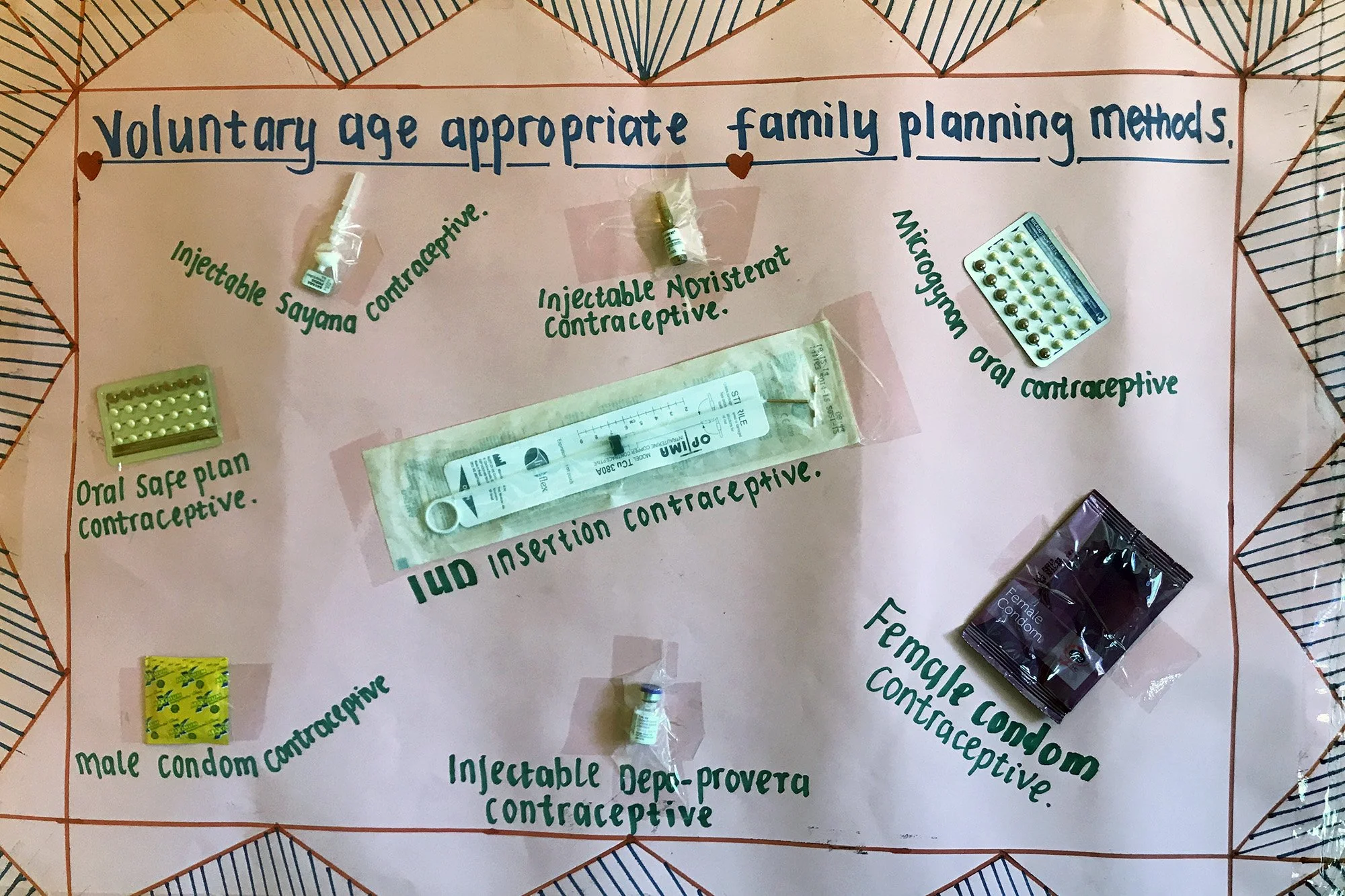
Family planning display in Zambia.
Shifting gender-based inequities
To better examine the systems that produce these inequities, practitioners sometimes use the gender integration, or gender transformative, continuum. The continuum is a framework used to classify how programs, policies, and organizations address gender norms and power relations. It ranges from approaches that actively harm to those that fundamentally dismantle systemic imbalances. As seen below, it ranges from exploitative to transformative.
While the continuum looks a little different depending on where you are looking or who is using it, its foundation remains similar. It goes beyond simply acknowledging gender differences and instead asks us to consider how programs interact with those differences. Do they reinforce existing inequities? Do they accommodate them? Or do they actively work to transform them? The continuum provides a visual framework and offers a tangible way to integrate gender into new or existing projects or programs.
Gender equality continuum tool
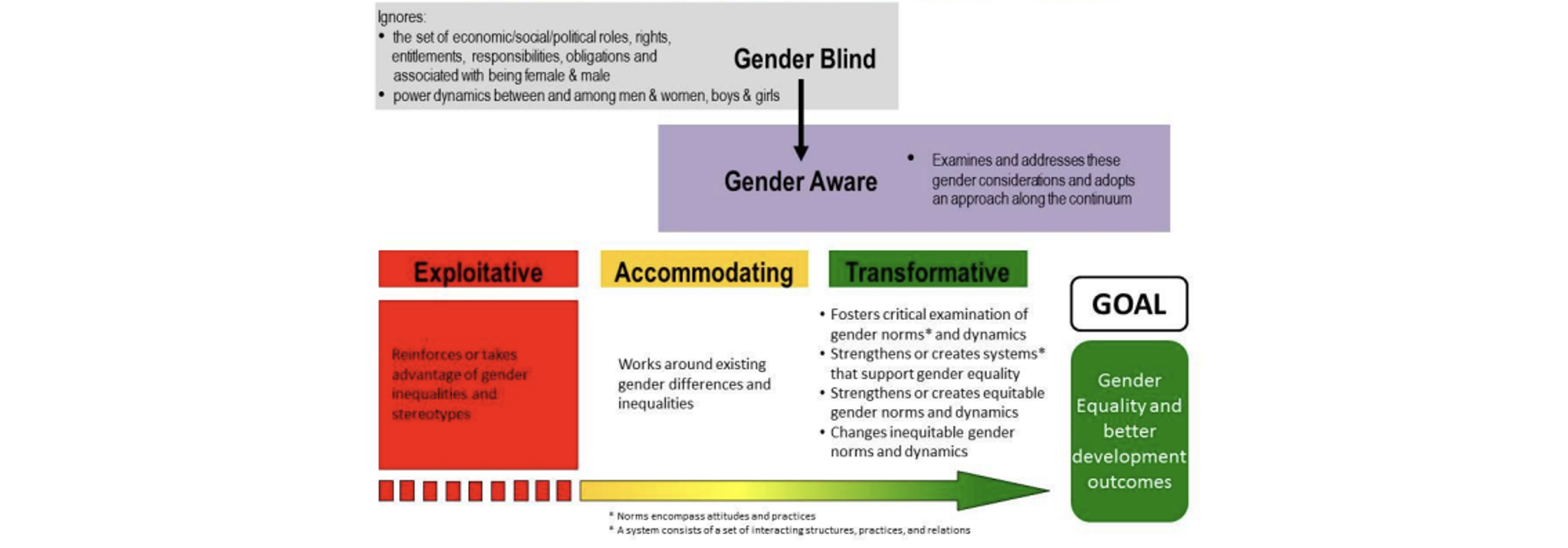
Source: Prevention Collaborative
What this looks like in practice:
Gender exploitative: A malaria prevention program is conducting indoor residual spraying (IRS) in rural communities. The program hires men as spray operators because it requires physical labor. Instead of questioning this assumption, the program uses local gender norms to exclude women from the paid jobs, telling the community that men should be the ones working outside of the home and earning income.
Gender accommodating: A community health worker (CHW) program recognizes that women CHWs may have difficulty traveling long distances or working after dark because of safety concerns or household responsibilities. Therefore, the program schedules visits during daylight hours, provides transportation, and assigns CHWs to communities closer to their homes.
Gender transformative: A maternal and child health program initially focuses on improving antenatal care and pediatric health. Instead of treating pregnancy and childcare as solely the women’s responsibilities, the program engages both parents, community leaders, and health workers in discussions about gender roles and decision-making. Both parents are encouraged to participate in antenatal health and share household and childcare responsibilities.
An easier way to remember the three:
| Approach | What the program does | Example |
|---|---|---|
| Exploitative | Uses gender norms | “Men work outside of the home and are more capable of having paid jobs.” |
| Accommodating | Works around gender norms | “Women CHWs have mobility and safety constraints, so we’ll adjust their schedules and transportation.” |
| Transformative | Challenges and changes gender norms | “Let’s change expectations about who participates in and provides childcare.” |
While gender is considered across the entire continuum, the end goal is to change the way a system operates. And a gender-transformative approach is the only one that changes who has authority and influence over the process itself.
Gender frameworks in global settings
Frameworks for understanding gender and power can’t really be applied without considering Indigenous histories and colonial disruption. Many pre-colonial societies across Africa, the Americas, and Asia operated in egalitarian systems. Women held distinct political, religious, and economic authority. Many societies were matriarchal or recognized a third or multiple genders. Colonization suppressed pre-existing gender fluidity and non-binary roles. Beyond forced displacement, land theft, and the dismantling of Indigenous governance systems, colonization actively and intentionally disrupted and reshaped relationships, family structures, and social roles, replacing them with systems designed to concentrate power and enforce colonial norms. As a result, many now experience stark socio-economic disparities, a reality shaped by the centuries of colonial disruption and sustained by modern systems.
In research, understanding these complexities requires listening to the communities whose experiences are being represented. Enter participatory research. If we are committed to transforming an inequitable system, then we must also be asking how power operates in the way knowledge is created. Who decides on the questions worth asking? Who guides the research process? Who determines how findings are interpreted? Again, these questions are just as important as the data we collect.
Participatory research is a collaborative approach where people affected by an issue will work directly with researchers as equal partners through every step of a study. The key difference between participatory and conventional research methods lies in the location of power in the research process. It increases community engagement, but its value extends beyond participation for participation’s sake. At its best, participatory research disrupts extractive approaches to the production of knowledge. It recognizes that community members are the experts in their own lives, experiences, and communities, positioning them as co-creators of that knowledge.
Are we just collecting input, or are we sharing power?
Instead of researchers being the sole interpreters of reality, participatory research methods invite communities to help shape research questions, interpret findings, and identify meaningful actions. The researcher’s role shifts from someone who’s in charge of the data to someone who facilitates the process and organizes the information.
That said, participation alone does not guarantee change. Participatory approaches can be tokenizing when communities are invited to provide input without being given the opportunity to have meaningful influence over decisions. It can also be extractive when hidden agendas, performative gestures of inclusion, or organizational and/or private interests overshadow the broader commitment to change. Real participation requires creating opportunities for people to design the direction of the work.
Participatory approaches do not always fit neatly into a spectrum. They take many forms depending on the community, context, and purpose. And, of course, funding. But like gender-transformative approaches, the goal of participatory research is a true shift in power.
Our research always tells a story, and it’s shaped by the people whose lives and experiences are represented within it. So, whose story are we telling?
Share